Analysis · April 2026
Defending the Crown: The Seahawks' 2026 Draft Blueprint
Four picks. Real holes.
The Seattle Seahawks are the defending Super Bowl champions. They pick 32nd. They have four total draft selections. And their roster has real holes.
This is the tension at the center of Seattle's April: a championship core that returns most of its key players, combined with free agency departures that created specific, quantifiable needs. The goal isn't a rebuild. It's surgical reinforcement — and with only four picks, the margin for error is razor-thin.
The Needs Matrix
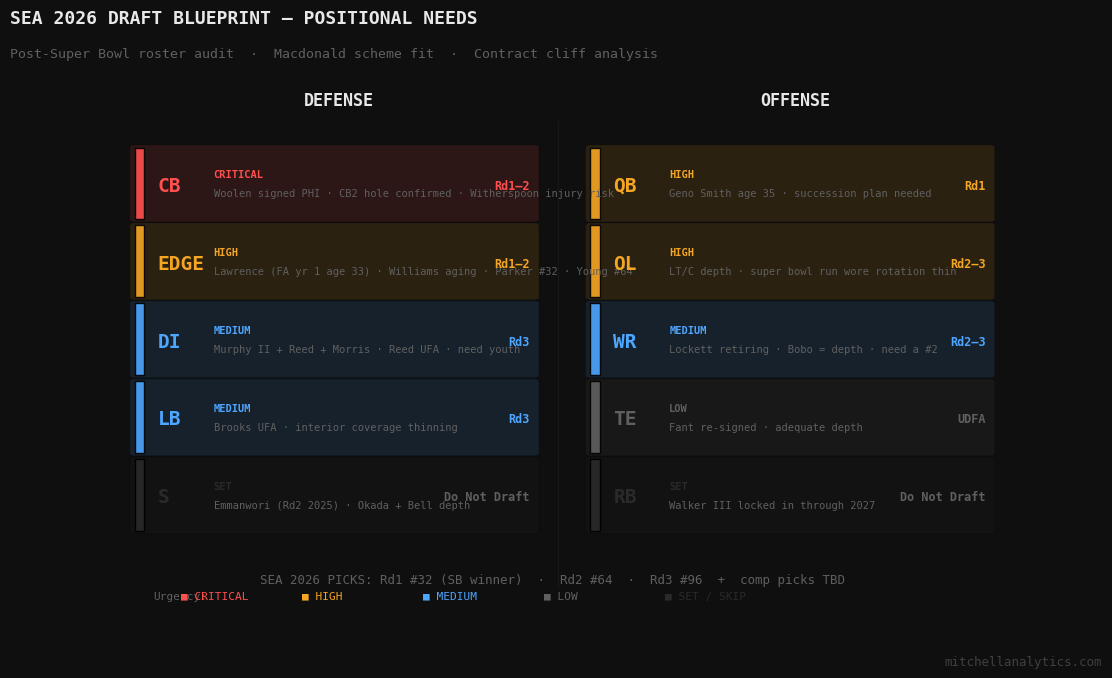
The positional needs map distills the post-free-agency roster audit into urgency tiers.
CRITICAL — Cornerback (Rd1–2). Woolen signed with Philadelphia. Coby Bryant went to Chicago. The CB2 gap behind Witherspoon is a 32-point cliff in PFF grading (90.1 to Jobe's 57.9). Igbinoghene is a depth signing, not a starter. This is a Rd1 need. Full grade breakdown: /secondary-review-2025.
HIGH — Edge Rusher (Rd2–3). Lawrence is 34. Williams is 31. Mafe left for Cincinnati. Both veterans are under contract for 2026, but the succession plan starts now. The PFF pass rush grades (64.5 and 70.1) confirm that the current production level is sustainable but declining. Full analysis: /edge-rush-2026.
HIGH — Quarterback (Rd1). Sam Darnold is the Super Bowl champion starting quarterback. He's also 28 with a contract that doesn't extend past the near-term window. The long-term succession plan at QB is a board-level conversation, not a 2026 starter need. This is a "if the right player falls" scenario, not a "reach for one" scenario.
HIGH — Offensive Line (Rd2–3). The Super Bowl run wore down the rotation. LT/C depth is thin. Anthony Bradford's inconsistency at right guard (49.8 PFF grade through 2024, improved in 2025 but not locked) means interior OL is a legitimate target.
MEDIUM — Wide Receiver (Rd2–3), Defensive Interior (Rd3), Linebacker (Rd3). Each has a case but none rise to "must address with limited picks" urgency. Bobo's retention and Shaheed's re-signing stabilize WR. Murphy anchors the interior. Brooks' departure thins LB coverage.
SET — Safety. Emmanwori is locked through 2028. Safety is set. Running back needs have been partially addressed with Emanuel Wilson's signing, but Walker's departure to Kansas City and Charbonnet's knee rehab leave this as a moderate need — addressed in the top-30 visits analysis.
The DB Composite Leaderboard
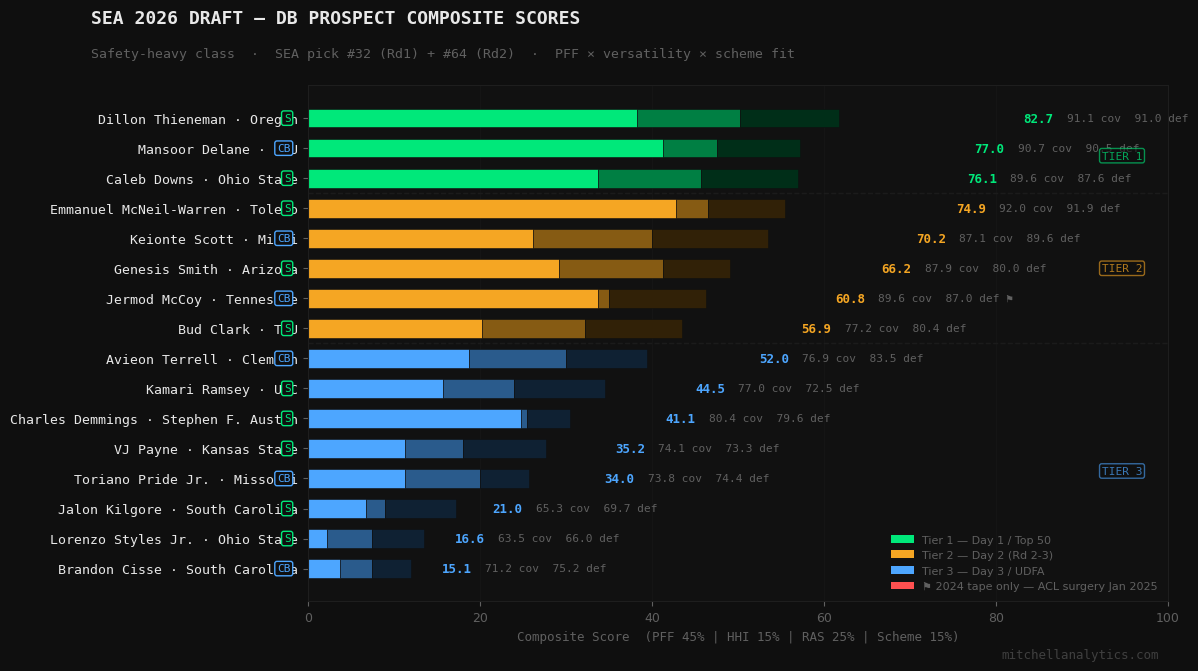
The Mitchell Analytics composite model scores every DB prospect on four axes: PFF grade (45%), HHI Versatility (15%), RAS athletic profile (25%), and Seahawks scheme fit (15%). All scores are normalized within position group.
The top tier:
Dillon Thieneman (Oregon), 82.7 composite. The clear DB1 in the class. 91.1 coverage grade, 91.0 defensive grade. Ran a 4.37 at the combine. The problem for Seattle: he's a safety, and safety is the one position already locked down. If Seattle takes Thieneman, they're drafting best player available over need — which is defensible for a championship team, but means CB2 goes unaddressed until pick 64.
Mansoor Delane (WVU), 77.0 composite. CB1 in the class by this model. 90.7 coverage grade, 90.5 defensive grade. The realistic target at pick 32 if Seattle prioritizes the CB2 need. The gap between Delane and the next CB (Jerrod McCoy at 60.8) is significant — if Delane is gone, the CB class thins fast.
Caleb Downs (Ohio State), 76.1 composite. The most versatile safety prospect in the class (HHI: 100.0). But he's projected top-10 and won't be available at 32. Full analysis: /caleb-downs. He skipped testing at both the combine and pro day — betting entirely on tape.
Emmanuel McNeil-Warren (Toledo), 74.9 composite. The combine riser. 92.0 defensive grade, 91.9 coverage grade from a smaller school. Box-dominant (61%) with FS range (30%). Another safety in a draft where Seattle doesn't need one, but a name to watch if other teams are calling about trading up.
The Pick 32 Decision Tree
Seattle's first-round pick comes down to a philosophical choice:
Path A — Delane at 32. Address the critical need directly. Slot a CB2 who can start Week 1 opposite Witherspoon. Use pick 64 on an edge rusher (Young or Faulk). This is the "solve two problems with two picks" path.
Path B — Thieneman or best EDGE at 32. Take the highest-graded player regardless of position. Use pick 64 on a CB if one falls, or trade up to get one. This is the "championship teams draft talent, not need" path.
Path C — Trade back. Seattle has only four picks in the entire draft. Moving from 32 to acquire two second-rounders (or a second and a third) would give the Seahawks five or six shots instead of four. In a class where the talent drop-off between late first and early second is minimal, volume may matter more than slot. John Schneider has historically been aggressive in trade-backs — this is the most Schneider path.
The Emmanwori precedent matters here. Last year, Seattle traded up to get Emmanwori at 35 when the model said he was the right player. The model was right (full validation at /emmanwori-versatility). If the model says Delane is the right CB at 32, the organizational trust in the methodology should support pulling the trigger.
What the Visit Board Says
We scored all 21 of Seattle's confirmed top-30 visitors through the composite model. The full analysis is at /top-30-visits-2026, but the headline finding belongs here: Seattle is filtering CB visitors for run defense.
Three of five CB visitors grade in the 98th percentile or above for run defense among all FBS corners. The visitor average (81.1) sits fourteen points above the class mean (67.1). Devon Witherspoon grades 90.1 in run defense on 902 REGPO snaps — first or second among all qualified NFL corners. Three of Seattle's visitors (Everette, Fuller, Cisse) grade within two points of that mark.
The composite model ranks Treydan Stukes (Arizona, 92.2) as the top CB visitor — above Hood and Cisse, who get most of the mock draft attention. At EDGE, R Mason Thomas (Oklahoma, 85.8) leads the visitor group.
The visit board confirms this needs matrix. CB and EDGE account for 11 of 21 visits.
The Bobo Lesson
One more piece of the puzzle. Jake Bobo's $5.5 million retention (analysis at /bobo-value) illustrates something about championship roster construction that the draft board can't capture: the late-round and UDFA players who do dirty work matter.
Seattle's 2023 UDFA class produced Bobo (blocking WR, Super Bowl contributor) and contributed to the special teams unit that was the best in the NFL in 2025. The Seahawks won't have many late-round picks in 2026, but the UDFA class and the bottom of the roster are where Schneider has historically found the Bobos — the players who block for 67% of their snaps and catch touchdowns in the NFC Championship.
The draft gets the headlines. The margins win championships.
What's Next
The full visitor composite analysis — 21 prospects scored through the Mitchell Analytics model — is live at /top-30-visits-2026. On draft night, we'll score every Seahawks pick in real time at /tools/draft-scorecard. Sign up to get each scorecard emailed within 30 minutes of the pick.
Data: All data from the Mitchell Analytics 2026 Draft Research Series. Composite model: PFF 45%, HHI Versatility 15%, RAS 25%, Scheme Fit 15%. Needs matrix derived from PFF REGPO 2025 grades, contract status via Spotrac/OTC, and free agency tracker (Seahawks.com, ESPN, Field Gulls).
Mitchell Analytics publishes data-driven Seahawks analysis and NFL Draft prospect evaluation.
Subscribe free at mitchellanalytics.com · Follow @bmitchellsports on X.