Analysis · Piece 4 · April 2026
Seattle's Edge Rush: Lawrence, Williams, and What Comes Next
The succession question at edge rusher
DeMarcus Lawrence is 34. Leonard Williams is 31. Between them, they combined for 19 sacks and 32 QB hits in Seattle's Super Bowl run, the soul and spine of a pass rush that ranked among the best in football.
Both are scheduled to be on the roster in 2026. Neither will be here forever. The 2026 NFL Draft is in three weeks. Seattle holds picks at #32 and #64.
This is the succession question nobody is asking loudly enough.
What Lawrence and Williams Actually Did
Before projecting replacements, it's worth being precise about what's at stake. The 2025 SEA pass rush wasn't just about sack totals — it was the combination of interior and edge disruption that made the defense function.
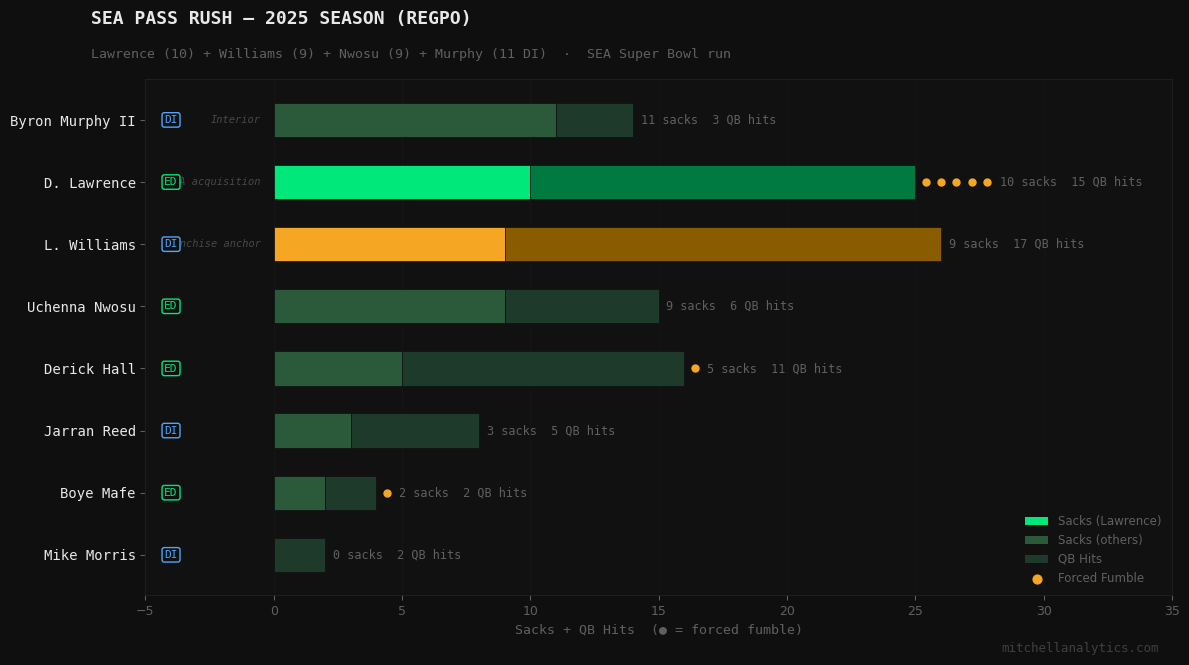
| Player | Pos | PFF Rush | Sacks | QB Hits | Tackles | FF | Games |
|---|---|---|---|---|---|---|---|
| Byron Murphy II | DI | 77.3 | 11 | 3 | 43 | 0 | 20 |
| D. Lawrence | ED | 64.5 | 10 | 15 | 36 | 5 | 19 |
| L. Williams | DI | 70.1 | 9 | 17 | 41 | 0 | 20 |
| Uchenna Nwosu | ED | 62.7 | 9 | 6 | 23 | 0 | 19 |
| Derick Hall | ED | 71.8 | 5 | 11 | 18 | 1 | 17 |
| Boye Mafe | ED | 69.2 | 2 | 2 | 24 | 1 | 20 |
| Jarran Reed | DI | 59.7 | 3 | 5 | 29 | 0 | 16 |
The depth of this unit is what stands out. Seven players with meaningful production. But the top two — Lawrence and Williams — account for a disproportionate share of the pressure quality. Williams' 17 QB hits on 9 sacks is an elite strip-sack rate. Lawrence's 5 forced fumbles on 19 games is unusual even for dominant edge rushers.
Murphy is worth calling out specifically. He's a 2024 draft pick in his second NFL season — his 77.3 PFF pass rush grade already leads this unit and his 11 sacks paced the entire front. His run defense grade (53.4) and alignment range (74% of snaps in the B-gap, rarely aligned outside the tackle) are genuine areas to develop. Both typically improve as young interior linemen gain experience reading blocks and expanding their technique. Murphy doesn't fill Williams' inside/out role today, but a Year 2 player grading 77.3 in pass rush has a development arc worth watching. The interior of this front could be very good for a long time.
These are two of the best players on the roster, and either or both can decide next year will start their life after football.
The Age Math
Lawrence is 34 on a two-year deal ($10.8M APY) locked through 2027. Williams is 31 — younger than his reputation suggests — but his 2026 cap hit is $29.6M with only void years beyond. Effectively, 2026 is his final contracted season.
Seattle drafts an edge rusher at #32 or #64 in 2026, that player realistically contributes as a rotational piece in Year 1 and a featured starter in Year 2–3. Should have some time for a rookie to develop alongside them.
The 2026 Draft Class at Edge
This is where the planning gets concrete. The 2026 edge class has genuine depth, with two distinct tiers relevant to Seattle's picks.
Tier 1 — Around Pick #32
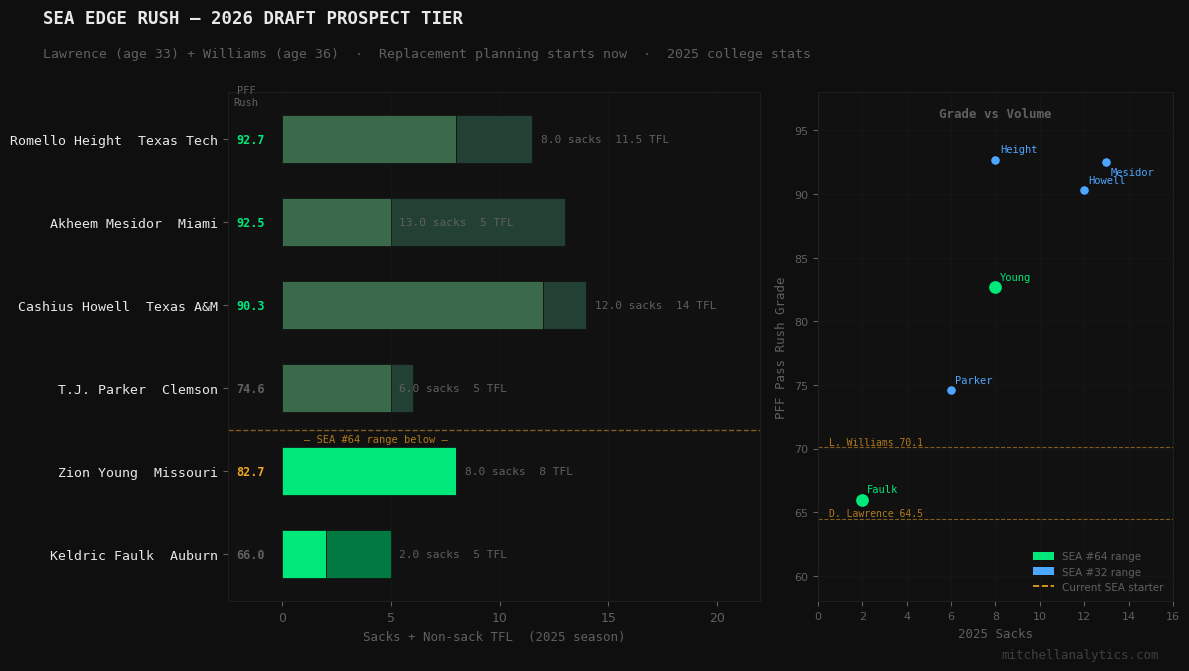
Four prospects project into the first-round range that includes Seattle's #32 pick. Two of them grade at an elite level that exceeds anything on Seattle's current roster.
| Prospect | School | Sacks | TFL | PFF Rush | Draft Est. | Note |
|---|---|---|---|---|---|---|
| Romello Height | Texas Tech | 8 | 11.5 | 92.7 | #30–50 | #1 PFF overall ED grade |
| Akheem Mesidor | Miami | 13 | 5 | 92.5 | #25–35 | Williams comp — inside/out |
| Cashius Howell | Texas A&M | 12 | 14 | 90.3 | #20–40 | Garrett-level PFF metrics |
| T.J. Parker | Clemson | 6 | 5 | 74.6 | #28–38 | Lawrence comp — power edge |
Mesidor is the Williams comp. He plays inside and out in Miami's front, runs the same bend-and-power move set Williams has refined over a decade, and his 13-sack 2025 season came against a schedule that included several of the better offensive lines in college football. Inside/out versatility maps directly onto what Macdonald values up front.
Height is the pure edge option. His 92.7 PFF pass rush grade is the highest in the class outright. His grade-to-production gap suggests he's winning more than box scores show, a pattern that tends to translate more to NFL pressure rates than raw sack totals.
Parker is the Lawrence comp. Power-based edge rusher who wins with leverage and hands rather than burst. Lower PFF grade than the top three, but a first-round projection on athleticism.
Tier 2 — Around Pick #64
If Seattle stays at its own picks and doesn't trade up, #64 is the more realistic edge rusher slot — depending on how the board falls at #32.
| Prospect | School | Sacks | TFL | PFF Rush | Draft Est. | Note |
|---|---|---|---|---|---|---|
| Zion Young | Missouri | 8 | 8 | 82.7 | #50–70 | SEA #64 range target |
| Keldric Faulk | Auburn | 2 | 5 | 66.0 | #25–40 | Run D elite (85.5) · raw rusher |
Young is the most complete #64 option. His 82.7 PFF rush grade clears Williams' 70.1 baseline while sitting squarely in the range Seattle can reach at their second pick. Not a Year 1 starter, but a genuine development piece with starting upside.
Faulk is the developmental flier. His run defense grade (85.5) is elite — he has the physicality and block-shedding that translates. The pass rush grade (66.0) reflects rawness in his pass rush repertoire. If Macdonald's staff can teach the moves, the physical traits are there. Lower floor, higher ceiling than Young.
The Decision Framework
Seattle's draft position creates a specific scenario: address CB (Woolen's departure) at #32 and target edge at #64, or flip the order depending how the board breaks.
The edge rush succession argument for going earlier than #64:
- Mesidor and Height don't fall to #64. If Seattle wants either, it's a #32 decision.
- Williams' inside/out comp is specific — not something found in later rounds.
- Lawrence's 5 forced fumbles in 19 games doesn't get replaced by a rotational piece.
The counter-argument:
- Lawrence and Williams are still here in 2026. Hole isn't open yet.
- CB position is a present-day vulnerability, not a future one.
- Nwosu and Hall provide enough edge depth to survive a gap.
The read: If Mesidor falls into the #32 range, Seattle should seriously consider taking him there. The Williams comp is rare and the succession timeline is real. If the top three edge prospects are gone at #32 and a CB is available who addresses the Woolen vacancy, that's the correct pick, and Young at #64 becomes the edge plan.
PFF grade captures a lot, but it doesn't capture two things that matter for Lawrence and Williams value.
First: Lawrence's pass rush IQ. His 5 forced fumbles in 19 games isn't just athleticism, it's anticipation. He knows when the quarterback is going to scramble and attacks the ball. A veteran skill that doesn't appear in any college prospect's stat line. Seattle's next Lawrence isn't going to show that dimension until later years of his NFL career.
Second: Williams' interior/exterior flexibility. The Mesidor comp is real, but Williams has spent a decade learning his craft. His off-script contributions, fourth-quarter adjustments, double-team manipulation, come from experience. A 2026 draft pick gets you the tools, not the mastery.
The draft is about building the players who are ready to take over in 2028, not the player who replicates what Lawrence and Williams will do for Seahawks next October.
Related: Full composite scores for all six EDGE visitors at /top-30-visits-2026.
Mitchell Analytics publishes data-driven Seahawks analysis and NFL Draft prospect evaluation.
Subscribe free at mitchellanalytics.com · Follow @bmitchellsports on X.