Analysis · Piece 2 · March 2026
The Model Was Right: Emmanwori's Versatility Score — and 2026 Predictions
Part 2 on the Seattle Seahawks' defensive build.
In Part 1, I showed how the Rams exploited a structural alignment problem in Seattle's 2024 defense. 13 personnel forced a binary that Seattle's roster couldn't solve: cover tight ends with linebackers (speed mismatch) or drop a safety into the box (coverage mismatch). The answer required a specific type of player, one who could eliminate binary.
The answer was visible in the college data before the 2025 draft opened.
Nick Emmanwori just completed his rookie season with the Seattle Seahawks as a Super Bowl LX champion — 5 tackles in the Super Bowl, 2nd-place finish in Defensive Rookie of the Year voting — deployed in exactly the role the model projected. Here's what the data showed before any of that happened, and what it now means for the 2026 class.
The Methodology
The HHI Versatility Score applies the Herfindahl-Hirschman Index — a tool from antitrust economics that measures market concentration — to snap alignment data.
A player who lines up 90% of his snaps from one spot has a high concentration score, which translates to a low versatility score. A player distributed evenly across three or four alignments has a low concentration score and a high versatility score.
But raw breadth isn't enough. Most defensive backs who line up at multiple alignments aren't there because they're good at it — they're there because the coaching staff needs a warm body. Distributing a 60-grade player across four spots isn't versatility. It's desperation.
The formula corrects for this with a grade consistency multiplier. A player whose PFF coverage grade clears 72 gets a 1.20x boost to his breadth score. A player grading below 52 gets penalized to 0.80x. The idea: reward players who actually graded out at multiple assignments, not just logged snaps there.
Two distinct things make a player deployable across formations: they have to be asked to do it, and they have to be good at it. The score measures both.
Emmanwori's College Profile
South Carolina 2024. 773 defensive snaps over the full season.
Alignment distribution:
| Alignment | Snaps | % |
|---|---|---|
| Box | 414 | 53.6% |
| Free Safety | 193 | 25.0% |
| Slot Corner | 146 | 18.9% |
| D-Line | 19 | 2.5% |
Versatility Score: 98.2 out of 100.
The number is high, but what makes it credible is where it came from. Emmanwori wasn't padding his alignment count with garbage snaps in the box during blowouts. PFF's own data put his box coverage grade at 90.2 — the best mark among all safeties in the country. As PFF noted in their 2025 Draft Superlatives: "His 90.2 coverage grade in the box this past season led all safeties in America. Emmanwori's three interceptions when lined up in the box led all Power Four safeties."
Not just gadget usage, genuine positional flexibility validated by the data.
The Historical Comp Class
Running the same calculation against comparable prospects produces a clear tier structure.
| Player | VS Score | COV Grade | Draft |
|---|---|---|---|
| Jessie Bates III | 100.0 | 70.1 | 2018 Rd2 #54, CIN |
| Jeremy Chinn | 100.0 | 82.5 | 2020 Rd2 #64, CAR |
| Kyle Hamilton | 98.7 | 80.8 | 2022 Rd1 #14, BAL |
| Nick Emmanwori | 98.2 | 86.8 | 2025 Rd2 #35, SEA |
| Kamari Ramsey | 96.4 | 77.0 | 2026 class |
| Antoine Winfield Jr. | 94.7 | 89.4 | 2020 Rd2 #45, TB |
| Budda Baker | 84.4 | 85.8 | 2017 Rd2 #36, ARI |
Emmanwori scores in the Hamilton/Chinn tier — the players who became starting-caliber NFL starters deployed across multiple roles. Winfield is a 2x All-Pro. Hamilton is arguably the best safety in football. Chinn became a linebacker-safety hybrid in his prime years.
Baker at 84.4 is the instructive contrast. His slot concentration (64.7% of snaps from that one alignment) pulls his breadth score down. He became excellent at his role — but his college data didn't show the same alignment range as the others.
One variable the score doesn't directly capture: raw speed. Emmanwori ran a 4.38 at 220 pounds at the NFL Combine. Jeremy Chinn — essentially the same build at 221 pounds — ran 4.45. Kyle Hamilton ran 4.59. That gap matters specifically for tight end coverage assignments in Macdonald's scheme, where a safety regularly gets matched against athletic receiving tight ends. Half a second in the forty at 220 pounds is a functional difference at the NFL level.
The Prediction
Using South Carolina 2024 we can develop deployment scenarios for Emmanwori's rookie year:
| Deployment Scenario | Probability |
|---|---|
| Box/Coverage Hybrid — primary alignment in the box with regular coverage assignments across the slot and at depth | ~65% |
| Traditional Safety Rotation — conventional FS/SS split without heavy box emphasis | ~25% |
| Slot/Nickel Hybrid — slot-dominant usage in lighter personnel groupings | ~10% |
The model projected the box/coverage hybrid at roughly two-thirds probability. That was the deployment that solved the Rams problem from Part 1.
What Actually Happened
NFL 2025. Seattle Seahawks. 19 games (regular season + playoffs).
Snap distribution (968 total REGPO defensive snaps):
| Alignment | Snaps | % |
|---|---|---|
| Slot | 469 | 48.5% |
| Box | 362 | 37.4% |
| D-Line | 113 | 11.7% |
| Wide Corner | 17 | 1.8% |
| Free Safety | 7 | 0.7% |
"By one count, he's only played 15 snaps as a true safety. He has more than 300 as a slot corner, more than 250 as a linebacker, about 30 as an outside cornerback and about 60 as an edge rusher."
Fox Sports, January 2026
"We had him at 9-technique, 5-technique, he's playing the slot."
Mike Macdonald, December 2025
In Emmanwori's own words: "I think that's the dream for any coach, to find a player that can literally do anything. Within our scheme, can be physical with tight ends, cover tight ends, cover receivers, cover running backs out of the backfield, whatever they need in one of the most unique defenses in the NFL."
The hybrid deployment materialized. The slot concentration ended up higher than projected (49% actual vs the box-heavy 65% model hybrid), driven in part by Macdonald's specific personnel deployment in 2025. His NFL Versatility Score — computed the same way — lands at 60.8, reflecting increased slot concentration versus his college distribution. (Note: this uses the recalibrated formula VS = (1−HHI_raw)×100 × (cov_grade/72.5), which aligns the score to the same scale as the historical comps in the slope chart below.)
The model projected the right deployment category. The specific slot-vs-box weight shifted, which is worth flagging: Macdonald found more slot value from Emmanwori than the model anticipated. The college breadth score correctly identified that he could play there — and he did, more than expected.
That result matters for how seriously to take the same calculation applied to the 2026 class. His NFC Championship coverage — covered in detail at /rams-adaptation — shows what the REGPO data confirmed: the deployment held up when games mattered most.
The Contraction Is Normal
With the full regular season plus playoff data included (968 snaps, 19 games), Emmanwori's REGPO alignment distribution holds steady: Slot 48.5%, Box 37.4%, Other 11.7%, Corner 1.8%, Free Safety 0.7%.
The more important number is the NFL Year 1 versatility score: 60.8. That's a 37-point drop from his college score of 98.2.
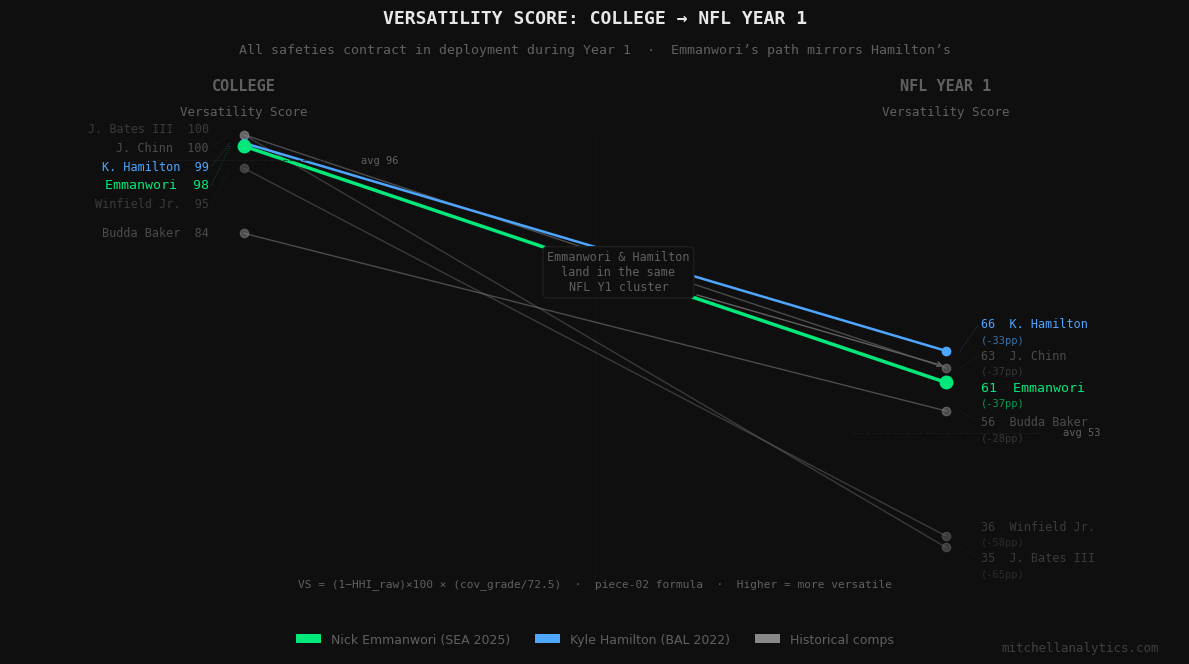
Every versatile college safety contracts in Year 1. Kyle Hamilton went from 98.7 to 65.8 (−33pp). Jeremy Chinn landed at 61.7. Budda Baker at 56. The pattern is consistent: NFL coordinators don't deploy rookies across five positions from Week 1. They find what works and build.
Emmanwori and Hamilton land in the same NFL Y1 cluster. That's not a coincidence — it's the model working as designed. College score identifies ceiling. NFL Y1 score reflects how quickly a coordinator trusts the player to expand.
Macdonald coached Hamilton in Baltimore. The defensive playbook is the same. Year 2 is where the expansion happens.
What's Next
One 2026 safety prospect is citing Emmanwori as his template — in his own words, at the NFL Combine this week. The model has alignment data on that comparison.
Part 3: Is Caleb Downs the next Emmanwori? The data has an answer.
Mitchell Analytics publishes data-driven Seahawks analysis and NFL Draft prospect evaluation.
Subscribe free at mitchellanalytics.com · Follow @bmitchellsports on X.