Analysis · March 2026
More Than Stats: What the Seahawks Get with More Jake Bobo
Two catches in the regular season. $5.5 million to keep him. The answer has almost nothing to do with receptions.
Jake Bobo caught two passes in the 2025 regular season. Total yardage: 20.
Yesterday, the Seattle Seahawks matched a two-year, $5.5 million offer sheet from the Jacksonville Jaguars to keep him. The deal carries $4.5 million in guarantees and can reach $7 million with incentives.
The reaction from most corners of the internet was predictable: why pay $5.5 million for a receiver with 34 career receptions? The answer has almost nothing to do with receptions.
The Snap Ramp
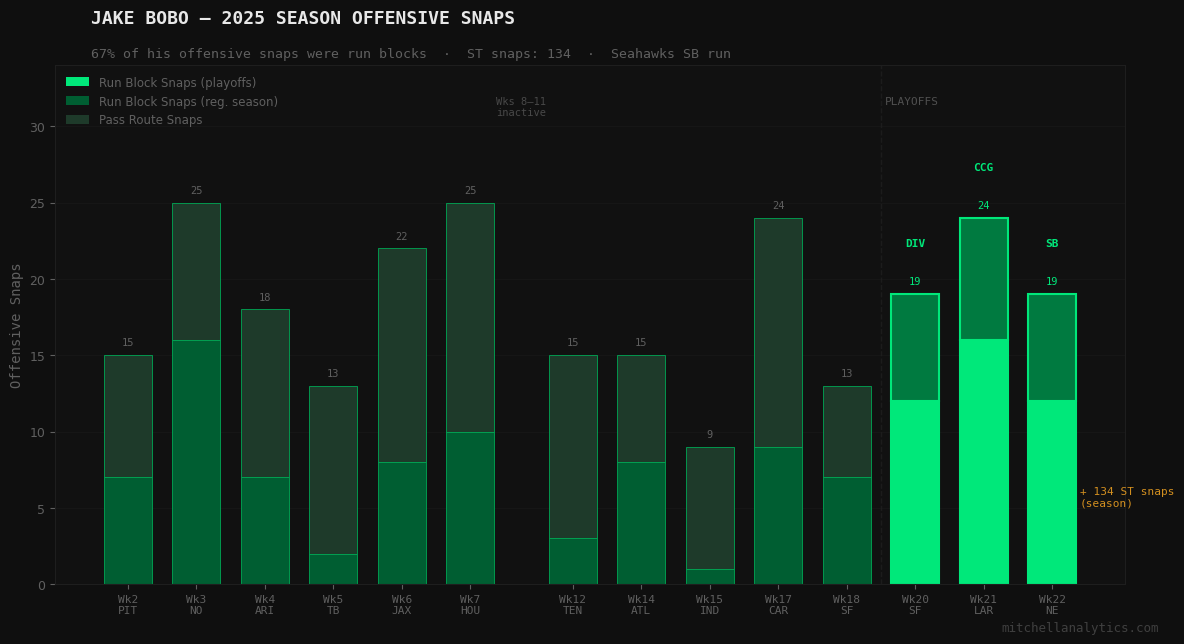
Bobo's offensive snap share jumped from 13% in the regular season to 21% in the playoffs.
Bobo played 117 offensive snaps in the regular season — 13% of Seattle's total. He missed three games to injury and was a healthy scratch for three more. On paper, that is not what you expect from today's wide receivers.
More Bobo during postseason. Week 17 through Super Bowl LX, Bobo's offensive snap share jumped to 21% of plays. 13 snaps in the wild card, then 19 (Divisional), 24 (NFC Championship), 19 (Super Bowl). When the games got bigger, Macdonald wanted more Bobo on the field — not less.
The NFC Championship is where it crystallized. Bobo caught a 17-yard touchdown from Sam Darnold that gave Seattle a lead they never gave back to the Rams. Two weeks later, with a broken hand requiring surgery from that same game, he suited up for the Super Bowl.
67% of his offensive snaps across the season were run-blocking assignments. That's the highest rate among Seahawks wide receivers. He also logged 134 special teams snaps. This isn't a part-time receiver — it's a full-time contributor whose job description happens to list "wide receiver".
A Blocker Who Catches, Not a Receiver Who Blocks
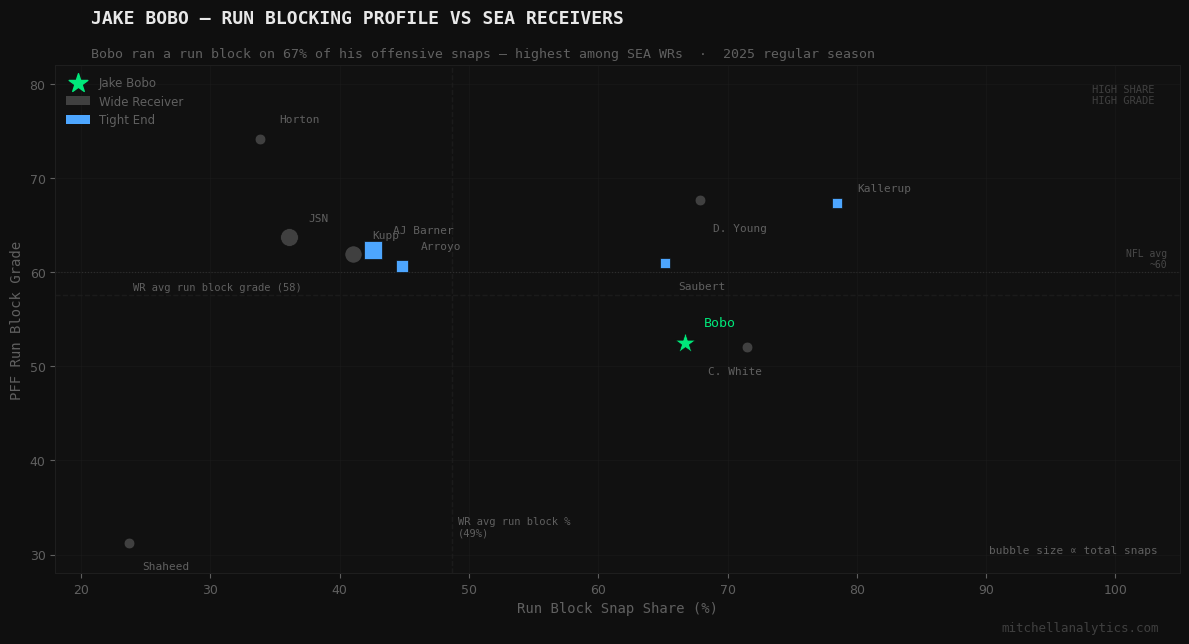
Bobo occupies a unique quadrant: high blocking share, moderate grade — a WR doing a TE's job.
The scatter plot shows every Seahawks pass-catcher by their run block snap share (X-axis) and PFF run block grade (Y-axis). Bobo occupies a unique quadrant: high blocking share, moderate grade — a WR doing a TE's job.
Jaxon Smith-Njigba runs a block on about 30% of his snaps. Shaheed barely touches 25%. Bobo is at 67%. The tight ends in the chart — Kallerup, AJ Barner, Arroyo — are the only players with comparable blocking share, and they're deployed as blockers by design. Bobo is the only wide receiver operating in that zone.
Down by Down
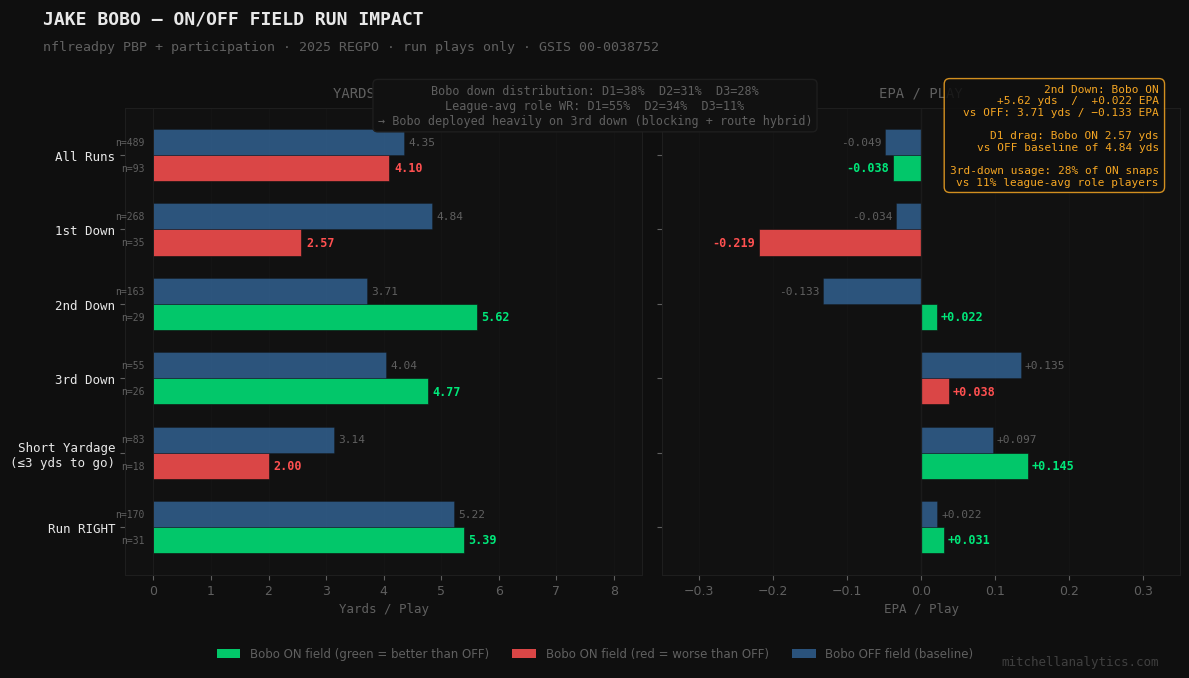
93 run plays with Bobo on the field vs 489 without. The down-by-down splits reveal his actual deployment pattern.
I pulled every run play from Seattle's 2025 season and split them by whether Bobo was on the field (93 plays) or off (489 plays).
The headline numbers are roughly even: 4.10 yards per carry with Bobo on the field, 4.35 without. But the down-by-down splits reveal his actual deployment pattern.
First down with Bobo on the field: 2.57 yards per carry, −0.219 EPA. Without him: 4.84 yards, −0.034 EPA. That's a significant negative correlation. Defenses may be keying on Bobo's presence as a formation tell, or the specific first-down run designs with him on the field (likely ISO concepts) are underperforming. Either way, on first down, Bobo's presence correlates with worse run outcomes.
Second down with Bobo: 5.62 yards per carry, +0.022 EPA. Without him: 3.71 yards, −0.133 EPA. A massive positive swing. His route threat on second down opens running lanes that don't exist when he's not on the field.
Down distribution tells the rest of the story. A typical role-player WR sees 55% of his snaps on first down and 11% on third down. Bobo's split: 38% first down, 28% third down. He's deployed on third down at nearly three times the normal rate.
Bobo's value is positional stress. On second and third down, defenses have to account for a 6'4" body releasing into a route. Hesitation creates space for the run game and for Seattle's other pass-catchers to work.
The Hogan Template
The Chris Hogan comparison is the right one. Hogan caught limited passes for the Patriots but was a meaningful contributor on three consecutive Super Bowl teams (2016–2018). His regular-season receiving numbers never wowed by traditional metrics. His blocking, special teams work, and trust from the coaching staff was an important piece of the Patriots' story.
Bobo's trajectory mirrors it. Two catches in the regular season. Two catches in the playoffs — including the touchdown that helped win the NFC Championship. The "More Bobo" movement started in 2023 training camp when RB coach Chad Morton coined the phrase. By Super Bowl LX, it wasn't a hashtag. It was part of a game plan.
What This Means for the Roster
Seattle's WR room entering 2026: Jaxon Smith-Njigba (just signed a $168.6 million extension), Cooper Kupp (33, veteran role), Rashid Shaheed ($51 million re-sign), Tory Horton (second-year), and now Bobo at up to $7 million.
Bobo isn't competing for targets. He's filling a role none of them can: the blocking WR who can line up as an extra tight end in heavy personnel, contribute 134 special teams snaps per season, and show up in the biggest moment of the postseason with a broken hand.
The Jaguars and pass game coordinator Shane Waldron, the former Seahawks OC who originally signed Bobo as a UDFA in 2023, agreed to the tune of $5.5 million guaranteed. Seattle didn't hesitate to match.
Championship teams aren't built on stars alone. Sustained success is built on players willing to block for 67% of their snaps and ready to catch a touchdown when it matters most.
Data: nflreadpy PBP + participation, GSIS 00-0038752, 2025 REGPO. All EPA calculations via nflreadpy expected points model. PFF grades via PFF+ subscription.
X / Twitter · Substack · hello@mitchellanalytics.com
© 2026 Mitchell Analytics. Independent. Not affiliated with the Seattle Seahawks or NFL.